
By John Paraskevas, Director, Etairos
On most commercial, industrial and apartment construction loans in Australia, the lender appoints a quantity surveyor, known as the lender’s QS. Before financial close, the QS prepares an initial cost report. At each drawdown after that, the QS inspects the site, assesses the builder’s claim against the work in place and issues a progress certificate with an updated cost to complete.
The QS is essential to a construction loan, and the certificate answers the questions it was designed for. How much work is in place. Whether the claim runs ahead of it. What it would cost to finish from today.
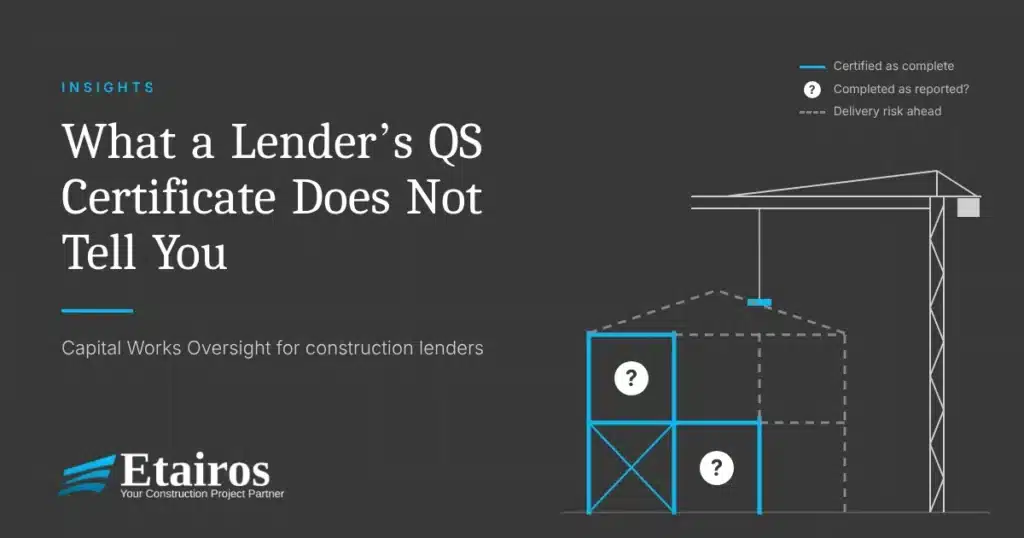
What it is not designed to answer is whether the project will be delivered. In our view, construction loans rarely go wrong on the cost report alone. They go wrong on program, contract administration, builder capacity and approvals, and those risks can build for months before they show up in a cost to complete figure.
What the Lender’s QS Certificate Covers, and What It Does Not
A lender’s QS certificate typically covers the following.
- Work in place against the builder’s claim
- Cost to complete from today
- Contingency remaining
- Retention held
- Movement in the budget since the last certificate
Delivery risk often sits outside it, or is only partly reflected.
- Whether the program is still achievable
- Variations and extension of time claims that are notified but not yet assessed
- Latent conditions and design gaps
- How the contract is being administered
- Builder resourcing, site numbers and subcontractor payment
- Authority approvals, services connections and commissioning
- Statutory measures and readiness for occupancy
A late program does not change the cost to complete until someone prices it. By then, the lender’s exposure has already moved.
Where the Lender Is Exposed
Delays, overstated variations, safety incidents, delayed procurement and substituted items each act directly on cost, value and time. This is where the lender is exposed, and each can be underway well before it shows in a progress certificate.
- Delays. Each month of delay adds capitalised interest and holding costs, can push the loan past its term and can put a sunset date in a lease or presale contract at risk. The longer the delay, the more time for market conditions to change. Rents, leasing demand, capitalisation rates and construction prices can all move, so the value the loan was written on may no longer hold at completion, and refinancing or sale on exit becomes harder to secure.
- Overstated variations. Variations claimed above their value, or without entitlement under the contract, erode contingency and draw the facility down for work that adds nothing to the asset.
- Safety incidents. A serious incident can bring a regulator’s prohibition notice, stopping work while it is investigated, with the cost and delay that follow.
- Delayed procurement. Long lead items ordered late push out the program, and prices can rise once quotes expire.
- Substituted items. Lower specification or non conforming products can reduce the asset’s value and service life, affect warranties and compliance, and may not be matched by a reduction in the contract sum.
Before Financial Close
The cheapest time to find delivery risk is before the first drawdown. In our view, four areas deserve a look alongside the QS initial cost report. It is a process to manage risk, not a judgement on the developer or the builder.
- The program. Whether durations, approval lead times and long lead plant such as switchboards, transformers and mechanical plant line up with the facility term and any sunset date in an agreement for lease or presale contract.
- The builder. Current workload, the team proposed for this project and how the builder has performed on similar work.
- Approvals and services. Planning conditions, staged building approvals and authority connections. On industrial projects, an electricity supply upgrade can be one of the longest lead items on the program.
- The delivery team and reporting. Who acts as Superintendent and project manager, whether a side deed with the builder gives the lender step in rights, and whether the lender’s representative can attend project control group meetings.
During Construction
Once works start, the aim is to hear about a problem when it is raised, not when it is priced.
- Project control group meetings and site walks. Attending alongside the delivery team, so issues reach the credit team early.
- Variations and extensions of time. Tracking claims from the day they are notified. Where a QS report carries only approved variations, a claim notified this month may not reach the cost to complete until it is assessed.
- Contract administration. Watching how claims and notices are being assessed under the contract. Late or missing assessments tend to turn into disputes, and disputes land on the program.
- Builder distress signals. Falling site numbers, trades leaving and not returning, subcontractors chasing payment or lodging security of payment adjudication applications, payment claims that front load preliminaries, requests to change payment terms and key site staff leaving.
- Reporting. A short report to the credit team that sits beside the lender’s QS certificate, set out below.
What Each Report Covers
Each report follows the same structure, so the credit team can read it against the QS certificate.
- Works completed. What was completed in the period, by area or trade, and what is underway now.
- Progress against program. Actual progress against the contract program, milestones met or missed and the current forecast date for practical completion.
- Risks reported and observed. Risks raised by the builder, the Superintendent and the project manager, including notified variations and extension of time claims, set against what we observe on site. This covers delays, variations, safety, procurement and substitutions, where they differ from what is reported, their likely effect on cost, value and time, and the questions the lender may want to put to the borrower.
How Capital Works Oversight Complements the QS
Capital Works Oversight, often called a lender’s representative role, is not a substitute for the lender’s QS, which remains essential to the loan. It complements the QS as a form of risk management for the lender. The QS certifies cost and progress. We report to the lender, as a governance function, on what we observe on site and in the delivery of the project. Together, they give the credit team one picture of the project.
We act solely for the lender, with no design or construction role on the project. Each engagement is bespoke, with a scope developed to suit the lender’s requirements and budget. The scope of oversight, reporting frequency and report content are agreed with the credit team at the start. Where specialist input is needed, we arrange it, coordinate it and report on it. Our reports go to the lender.
Engagement can start before credit approval, at financial close or part way through a facility when the credit team wants a closer view of delivery.
Talk to Etairos
Etairos provides Capital Works Oversight for lenders funding commercial, industrial and apartment projects in Victoria, New South Wales, Queensland, South Australia and the ACT. If you fund construction and want a clearer view of delivery risk alongside your QS reporting, call 1300 001 699, email enquire@etairoscpp.com.au or use our online contact form.
This article is general information only. It is not legal, financial or professional advice and does not take your circumstances into account. Seek advice specific to your project before acting on it.